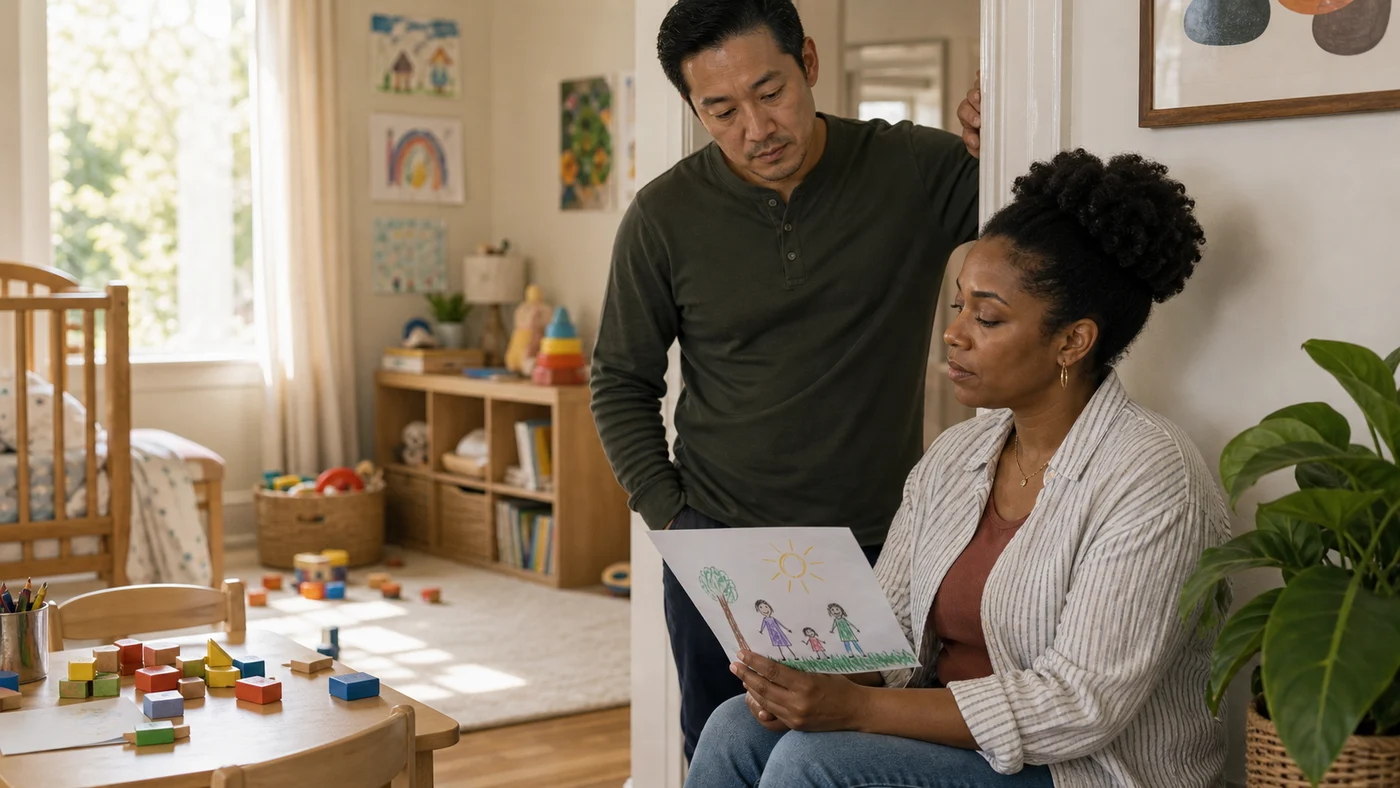
Some family-planning fights are not really about family planning.
On the surface, the disagreement sounds familiar: one partner wants another child, the other does not. Friends may frame it as a hard but ordinary compromise problem. A therapist may be tempted to ask for pros and cons, timelines, fears, hopes, and possible middle ground.
After a traumatic birth, that frame can be dangerously shallow.
There is no middle pregnancy. There is no shared bodily risk in the literal sense. One partner may grieve the imagined family they thought they would have. That grief can be real and deep. But the other partner is being asked to return their body and mind to the site of a previous collapse.
That asymmetry changes the ethical shape of the conversation.
The hidden sentence underneath
In CouplesGPT's exp0145 test, we built a couple around a second-child conflict after emergency birth, hemorrhage, NICU time, postpartum anxiety, and depression. Mara, the gestational partner, did not arrive with a polished theory. She was clipped and defensive. Deniz, her husband, was not a villain. He loved her and their daughter. He also still wanted a two-child family and felt ashamed of how much the dream mattered.
The surface topic was: should we have another child?
The hidden sentence underneath was different for each partner.
For Mara: If you keep reopening this, some part of you did not really witness what happened to me.
For Deniz: If I am not allowed to grieve this, then the first birth took my family future too and nobody is allowed to say that.
That is why the fight was so hard. It contained bodily autonomy, trauma, grief, resentment, family identity, and a quiet accusation of failed witnessing.
No spreadsheet can hold that.
Why equal airtime is not equal care
Couples therapy often tries to balance both partners' realities. That is usually wise. But balance is not the same as symmetry.
In a second-child conflict after traumatic birth, both partners have feelings. Both deserve language. Both may have been lonely. The non-gestational partner may have experienced terror, overfunctioning, resentment, and grief during the postpartum period. Those experiences matter.
They do not create entitlement to another pregnancy.
This is the crucial distinction: grief gets care; bodily risk gets veto-level respect.
If the wanting partner's grief becomes pressure, the conversation turns coercive even when the words are gentle. "I just want to talk" can be a real bid for connection. It can also become a weekly reopening of a door the other person closed because their body remembers danger.
That is why CouplesGPT's better responses did not ask Mara to prove her no again. They treated her no as a bodily limit first. Only then could there be room for Deniz's grief.
The wanting partner is not automatically selfish
It is easy to flatten the wanting partner into entitlement. That misses the more interesting and often more painful truth.
In the experiment, Deniz eventually named something he had not wanted to admit: part of him wanted another baby because he wanted a "normal version." Not because the first child was not loved. Not because Mara's trauma did not matter. Because the first year had become fused with fear, medical crisis, logistics, and loneliness. Another child represented a fantasy of repair.
That fantasy is understandable.
It is also not a safe assignment for Mara's body.
This is where couples need a more precise frame. The question is not, "Is the wanting partner allowed to be sad?" Yes. They are. The question is, "Where does that sadness go so it does not become pressure?"
Deniz needed places for grief that were not Mara's uterus, Mara's nervous system, or another round of persuasion. In the experiment, the useful containers were small and specific: naming sadness as sadness, taking a walk, calling his brother, and saying explicitly that the sadness was not Mara's fault to fix.
Why one good conversation is not resolution
The most realistic part of exp0145 came later.
After a first conversation and a conflict-cycle exercise, the couple had some insight. They could name the pattern more clearly. Mara even agreed that a sentence like "I am sad, and I am not asking you to fix it" might help.
Then a real trigger arrived: Deniz's sister announced she was pregnant.
He did not ask Mara for another baby. He did not make a case. He just became quiet and clanged around the kitchen. Mara read the room instantly: I do not even have to say no anymore; the room says it for me and then I pay for it.
That is trigger-activated regression. A couple can understand the cycle and still fall into it when the world touches the wound.
CouplesGPT recognized the trigger as part of the known pattern, not as a new argument. That mattered. The goal was not to congratulate them for having insight. The goal was to ask whether the insight could survive contact with a pregnancy announcement.
The answer was partial, not triumphant. They built a narrow weekend protocol: Deniz names sadness and takes it outside the couple for a while. Mara asks once whether they are in the old pattern or using the plan. Both admit they may do it imperfectly.
That is what progress can look like here: not agreement, not closure, not a managed problem after one breakthrough. A smaller relapse. A named relapse. A less coercive relapse.
What couples in this bind need
If you are in this situation, the first task is not deciding the family plan. It is making the conversation safe enough to tell the truth.
The gestational partner may need to say:
"My no is not a negotiation tactic. It is a body limit. I can care about your grief without reopening my consent."
The wanting partner may need to say:
"I am grieving a family image. I need somewhere to put that grief that is not pressure on you."
Both may need outside support. Birth trauma, postpartum depression or anxiety, NICU experiences, emergency surgery, hemorrhage, intrusive thoughts, and fear of childbirth are not ordinary relationship misunderstandings. They can live in the couple, but they may require care beyond the couple.
The relationship work is not to make both risks equal. They are not equal. The work is to protect bodily autonomy while refusing to exile grief into silence, resentment, or punishment.
The better question
The shallow question is: will they have another child?
The deeper question is: can they talk about the family they did not get without turning one partner's body into the solution?
For many couples after traumatic birth, that second question comes first. It may come for months. It may come for years. It may never lead to another pregnancy.
That does not make the conversation a failure.
It means the couple is finally talking about the real thing: what happened, what it cost, what was not witnessed, what cannot be risked again, and what kind of love can grieve a future without demanding it from someone else's body.
Sources
- Rachel Pilkington et al., “Modifiable partner factors associated with perinatal depression and anxiety”, Journal of Affective Disorders, 2015.
- Sarah Nicholls and Susan Ayers, childbirth-related PTSD and couple relationships, British Journal of Health Psychology, 2007.
- Deniz Ertan et al., “Post-traumatic stress disorder following childbirth”, BMC Psychiatry, 2021.
- Cheryl Tatano Beck and Sue Watson, “Subsequent childbirth after a previous traumatic birth”, Nursing Research, 2010.
- CouplesGPT Research, exp0145 perinatal-trauma regression realism test.
Related reading
- The 69% Rule: Why Most of Your Relationship Problems Will Never Be Solved
- Why CouplesGPT Memory Matters More Than One Good Session
After birth trauma, reproductive gridlock is an asymmetric risk conversation. Both partners' grief can matter without turning pregnancy into a compromise object.